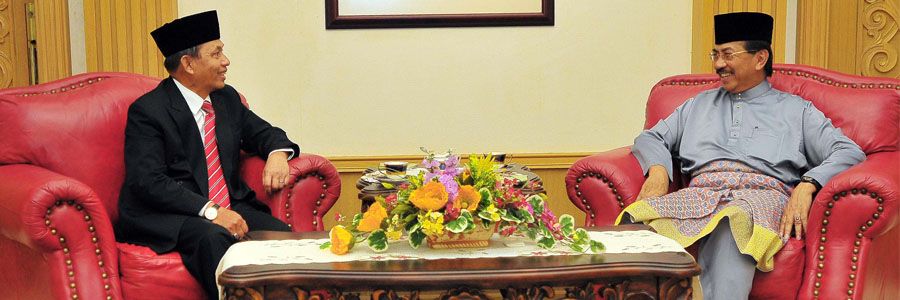


The Oxford Business Group (OBG) has interviewed the Sabah Chief Minister, Datuk Seri Panglima Musa Aman, on Sabah economic plan and achievement. This was taken from sabahkini.net websites. Click HERE to go to the original source.
-----------------------------------------------------------------------------------------------------
THE KEYS TO DEVELOPMENT
By : OXFORD BUSINESS GROUP


*Picture taken from animhosnan.blogspot.com, insightsabah.gov.my & nst.com.my
-----------------------------------------------------------------------------------------------------
THE KEYS TO DEVELOPMENT
By : OXFORD BUSINESS GROUP
THE 10th Malaysia Plan (10 MP) has identified 12 key economic areas that will drive the national economy from middle-income to high-income status. Four areas relevant to Sabah’s economic agenda are the tourism, agriculture, oil and gas, and palm oil industries.
Read the OBG Talks To Chief Minister of Sabah, Datuk Seri Panglima Musa Haji Aman as stated below.
 |
| Datuk Seri Panglima Musa Aman (NST) |
OBG : What impact is the Sabah Development Corridor (SDC) having on the state's enonomic growth?
MUSA: The state’s economy has proven to be quite resilient since the launch of the SDC on january 29, 2008. At the height ofthe recent global economic downturn, the growth of the advanced economies declined to 0.2% and -3.2% in 2008 and 2009 respectively, while Malaysia recorded 4.7% and -1.7% in the same years.
Sabah, on the other hand, registered 7.7% in 2008 and managed to remain positive at 3.3% in 2009. We are expecting the state's economy to ride through the global economic rebound in 2010 and strengthen further in 2011, driven by government spending, buoyant commodity prices and new investment.
Annual GDP growth is expected to average at more than 7%. Looking at the performance of the SDC thus far, since the beginning of the Ninth Malaysia Plan, which was also the timeline of the first phase of SDC, Sabah’s mean gross monthly household income increased to RM3102 ($972) in 2009, from RM2395 ($751) in 2004.
The average growth rate of income was recorded at 5.3% over the period 2004-09, and poverty incidence declined from 24.2% in 2004 to 19.7% in 2009. The SDC has had a largely positive impact on economic growth.
OBG : What areas of the economy are being targeted to attract an increase in private sector investment?
MUSA: The 10th Malaysia Plan (10 MP) has identified 12 key economic areas that will drive the national economy from middle-income to high-income status. Four areas relevant to Sabah’s economic agenda are the tourism, agriculture, oil and gas, and palm oil industries.
 |
| Sabah Fruits, Lankayan Island, Oil rig & Oil Palm Fruit |
The economic contributions of these industries are expected to increase over the course of the 10 MP? Key industries identified by the state government under the SDC programme are resource-based industries such as palm oil, cocoa and rubber; food processing industries involving fruits and vegetables, marine and aquaculture products, dairy and livestock; petro-chemical and gas industries; and silica-based industries.
Emphasis will be given to enhancing productive capacity, including developing advanced industrial infrastructure, the promotion of human capital development and research and development (R&D) activities, and the promotion of knowledge-based industries.
At its launch on January 29, 2008, SDC received a major boost with the signing of 13 agreements and memoranda of understanding worth RM16bn ($5bn). The proposed investments from the private sector were in biodiesel, agriculture, agro tourism, shopping, health and medical tourism, and transportation.
These projects are now at various stages of implementation. For the years 2011-12, coinciding with the First Rolling Plan of the 10 MP we will continue to implement these policies in addition to other initiatives in tourism, agriculture, manufacturing and infrastructure.
The SDC programmes are designed to achieve the socioeconomic objectives of Sabah by harnessing unity in diversity and natural resources to catalyse investments into new growth areas. The programmes and projects will be funded by a combination of public funds private sector investments and private finance initiatives.
To support this objective, a competitive package will be customised to attract private sector investment in the promoted sectors, especially in knowledge-intensive sectors such as the biotech and ICT industries, and in designated strategic development areas (SDAs).
Anchor companies and SME's, as well as start-ups and quality new investments, wi|l be encouraged to venture into the targeted sectors within the flagship economic clusters and projects in the designated SDAs.
OBG : The second phase of SDC aims to further strengthen the economy by promoting the growth of the SME segment. How can this aim be achieve?
MUSA: lt is important to note that the development of SMEs will not only support the larger multinational companies (MNCs) but also provide an avenue of future growth for Sabah. We will also launch SME Accelerator programmes such as the Manufacturing Leaders
 |
| Sabah SME product being exhibited |
Programme and SME Agro-preneur Programme in which companies at different stages of development (from the early stages through to the expansion stage) will have access to customised support services.
An SME accelerator programme will initially be established at Sabah Agro-Industrial Precinct to primarily nurture and support agro-entrepreneurs. Business Link centres will also be established to deliver business advisory services to local SME's.
The advisory services would cover areas such as operational improvements, matchmaking with potential buyers and suppliers, and marketing and design for exports. Anchor companies will be aided in starting up businesses in each of the economic clusters within the SDAs. SME's and start-ups will be encouraged to engage with relevant anchor companies through the Business Link centres.
In addition to the above measures, detailed sub-sectoral studies have been commissioned by the Sabah Economic Development and Investment Authority (SEDIA) in industries regarded as having high economic impact such as tourism, oil and gas, and biomass industry with a view to identify opportunities for SME's.
SEDIA shall also continue with existing programmes being implemented to support SME's, especially under the Economic Transformation Programme laid out in the 10 MP.
Sabah has a number of traditional sources of wealth. such as plantations, commodities oil and gas. which new sectors is the SEC going to promote?
OBG : Sabah has a number of traditional sourceof wealth, such as plantations, commodities, oil gas. Which new sector s is the SDC going to promote?
MUSA: The Malaysian government, through the 10MR has recognised the role of science and technology in transforming Malaysia into a knowledge-based economy and a developed nation by 2020.
The plan emphasised the adoption and diffusion of new technologies and innovations of ICT, biotechnology and other technologies, especially in the identified key economic areas.
Malaysia, and Sabah in particular will benefit from higher investment in niche growth areas such as biotech, green industry, wellness and health care, particularly through the intensive use of knowledge, innovation and technology, leveraging on its unique factor endowments.
SDC endeavours to intensify human capital development and leverage the current expertise within the research communities to create sustainable management of natural resources and biodiversity, as well as promoting science-industry linkages in tourism, agriculture, manufacturing and logistics.
An initial step in this direction involves the establishment of the Business link centres and the Sabah Bio-Xchange Network. This will help to pool resources and expertise and alleviate the shortage of human capital development in the short term. ln the longer term, measures will be taken to attract renowned training and research institutions to increase the pool of local talent, especially into the Sandakan Education Hub, as well as the lnterior Education Hub. Rural communities will also be empowered to access appropriate technology.
Additionally, Sabah’s rich, multi-ethnic cultural heritage, together with the scenic islands, unpolluted environment and the natural endowments such as rare wildlife, tropical rainforest and diverse marine life, should help to inspire the emergence of creative industry. In the past Sabah has hosted numerous television and film producers from international production houses. Under the SDC initiative, we see the potential for continuing to develop creative industry in Sabah.
There is, however, a dire need to invest in and facilitate access to technology and scientific knowledge. With science and technology driving innovation and also serving as a key economic and industrial enabler for new sources of growth in biotech, green industry, wellness and health care, as well as in the creative industries, jobs can be created and better access to health care and education can be provided.
From this development, small and large business owners can be net-worked and better connected to customers and new investment opportunities can be created, resulting in sustainable improvement in the standard of living and the economy, making Sabah an important destination for future investment in business, culture and nature.
*Picture taken from animhosnan.blogspot.com, insightsabah.gov.my & nst.com.my


